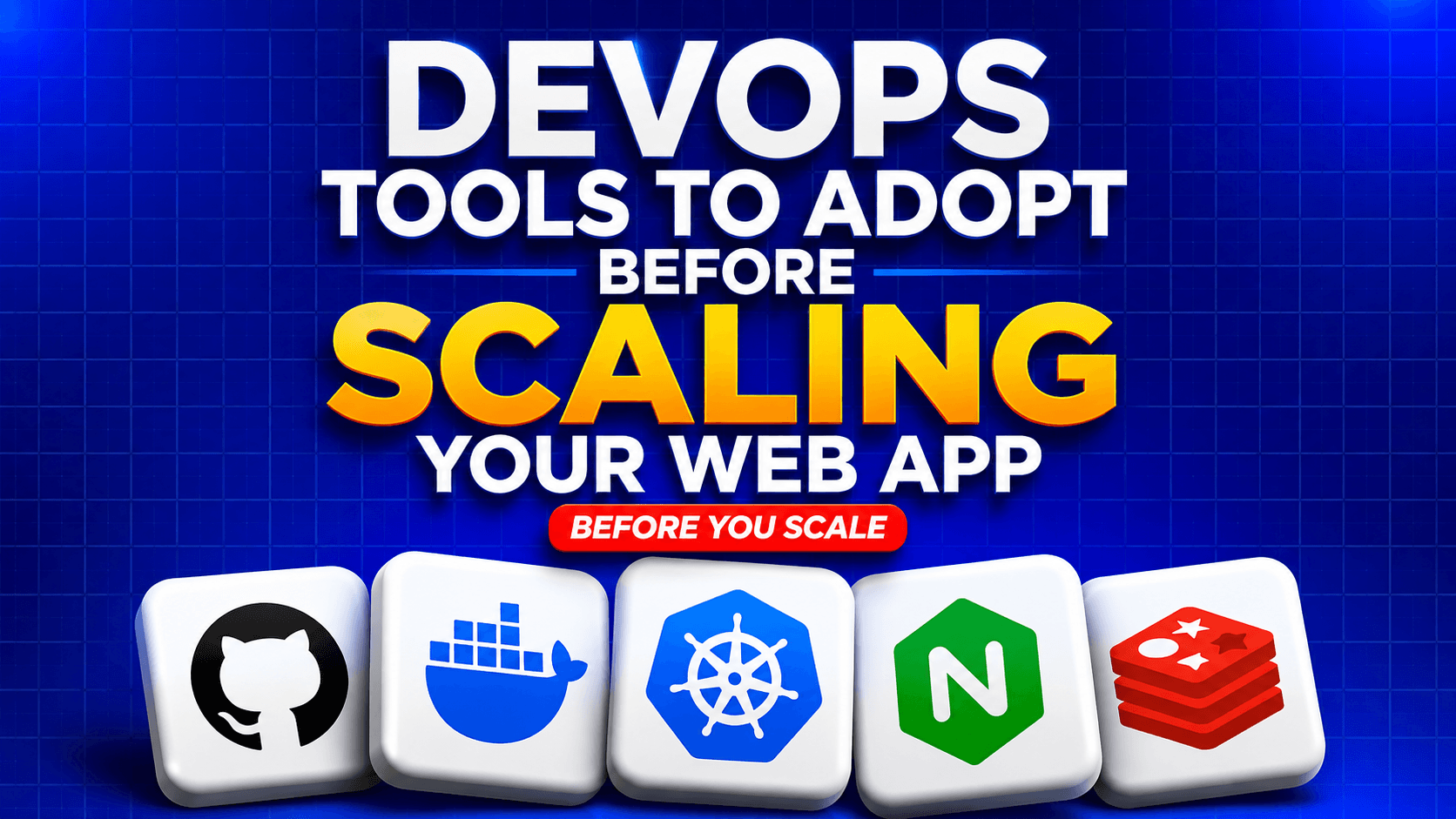
Scaling rarely breaks code. It exposes weak foundations. Once traffic grows, manual deployments, fragile processes, and missing visibility turn small cracks into full outages.
Scaling a web application rarely breaks code. It exposes weak foundations. When traffic grows from a few thousand users to tens of thousands, the cracks in your deployment process, environment consistency, and observability start to show. Slow deployments, random crashes, database overload, and late-night SSH sessions become routine. The fix isn't a bigger server or a fancier architecture. It's adopting the right DevOps tools before you need them.
The most common scaling failures come from manual, fragile processes. If you're still deploying by SSHing into a server, pulling code, installing dependencies, and hoping nothing breaks, you're setting yourself up for disaster. Containerization with Docker solves this by packaging your application and its dependencies into a consistent environment that runs identically on your laptop, in staging, and in production. You build once and run anywhere. No more 'it works on my machine.'
Managing Multiple Services with Docker Compose
As your application grows, you'll likely run more than one service: a Node API, a MySQL database, Redis for caching, and background worker queues. Manually configuring each service and its dependencies becomes error-prone. Docker Compose lets you define and run multi-container applications with a single command. It makes your local development environment predictable and mirrors your production setup, reducing the chance of environment-related surprises.
Handling Traffic with Nginx
Once traffic increases, your application server shouldn't be directly exposed to the internet. A reverse proxy like Nginx sits in front of your app and handles load balancing, SSL termination, caching static assets, and rate limiting. This reduces the load on your Node process, manages HTTPS cleanly, and can help prevent brute-force attacks. Without it, your app may struggle under traffic spikes that Nginx can absorb easily.
Process Management with PM2
Node.js is single-threaded, which means one crash can take down your entire application. Process managers like PM2 keep your app running by automatically restarting it on failure, running it in cluster mode to use multiple CPU cores, monitoring memory usage, and enabling zero-downtime reloads. This resilience is crucial for scaling—not just handling more users, but surviving failures without manual intervention.
Automating Deployments with CI/CD
Manual deployments don't scale. When you're doing everything by hand, you forget steps, skip tests, and deploy broken code. Continuous integration and continuous deployment (CI/CD) tools like GitHub Actions automate the pipeline: push code, run tests, build a Docker image, and deploy automatically. This removes the fear from deployments and makes shipping feel routine—which is exactly what you want. A boring deployment is a good deployment.
Boosting Performance with Caching
When your API slows down, the natural instinct is to optimize database queries. But often the real fix is caching. By storing frequently accessed responses in Redis, you reduce the number of requests hitting your database. This drops response times, reduces database load, and helps your API handle traffic spikes. Scaling is often about doing less work, not faster work.
Monitoring with Prometheus and Grafana
Guessing about system health is dangerous. Before monitoring, debugging often meant checking logs and hoping. With Prometheus and Grafana, you can track memory spikes, CPU bottlenecks, request latency trends, and error rates. Metrics give you visibility into how your system behaves under load, which is essential for proactive scaling. Without visibility, you're driving blindfolded.
Centralized Logging with the ELK Stack
When your application runs on multiple instances, logs become scattered. Debugging by SSHing into each server is chaotic. Centralized logging with the ELK stack (Elasticsearch, Logstash, Kibana) aggregates logs in one place. You can search errors instantly, track patterns, and correlate incidents across instances. Scaling increases complexity; logging reduces confusion.
Database Indexing
One of the most impactful performance improvements comes from proper database indexing. Without indexes, simple queries become slow as data grows. Adding appropriate indexes can turn queries that take 800 milliseconds into 10 milliseconds. No fancy infrastructure is required—just smarter database design. It's a fundamental skill that pays off immediately under load.
Health Checks and Auto-Restart Policies
When your app crashes at 3 AM, you don't want to wake up. You want automation. Docker restart policies, PM2 auto-restart, and health check endpoints allow load balancers to detect unhealthy instances and route traffic away. This small feature has a massive impact on uptime. It ensures your system self-heals without manual intervention.
The Real Lesson
Scaling isn't about Kubernetes first, microservices everywhere, or fancy cloud buzzwords. It's about stability, automation, observability, and repeatability. Most scaling pain isn't caused by traffic—it's caused by poor DevOps foundations. If you're starting a new app, Dockerize on day one, add CI/CD before your first production deploy, set up monitoring early, structure logs properly, and use caching from the beginning. Because scaling doesn't announce itself. It sneaks up on you. And when it does, you either have infrastructure ready or you learn the hard way.