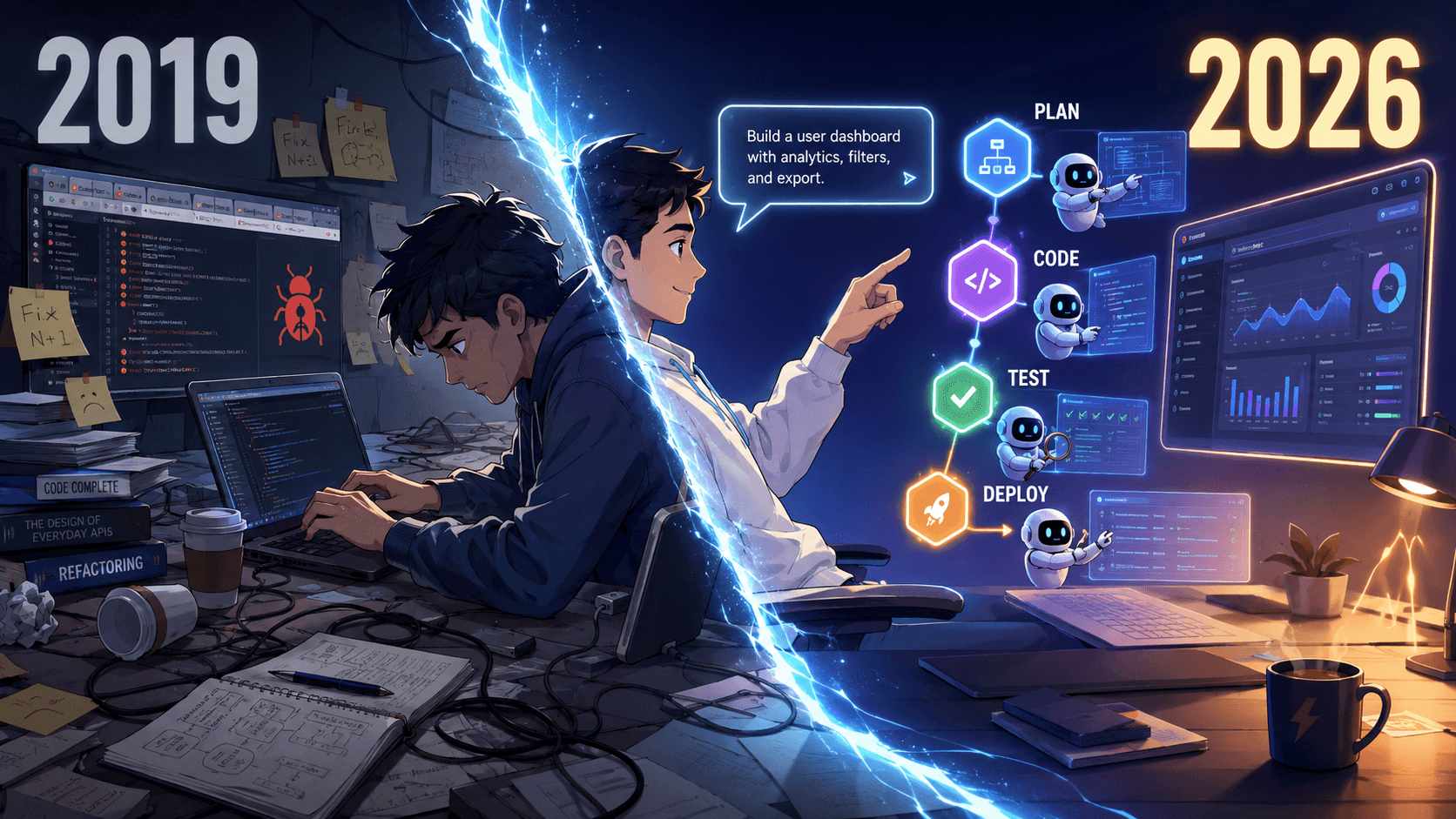
Three days. That’s how long it took me to burn through $200 in API costs on top of my $100 Claude max plan while working on a client’s project to get a production-ready RAG system completed. Watching the bill climb, I realized this is exactly how the job works now.
That week gave me a kind of cognitive shock—not panic, but the sudden clarity of seeing how fast the ground has shifted under a role I’d spent years building. Coding in 2026 is not coding in 2019. It’s not even close. And most of the conversation happening online about this still hasn’t caught up to what’s actually true on the ground.
The shift is not incremental. It’s structural. Teams are getting smaller, the job description has changed, and the skills that get you hired are no longer the ones most of us trained on. Understanding what’s really happening—and what it means for your career—requires looking past the hype and seeing the concrete mechanics of how work gets done now.
Teams Are Getting Smaller, Not Bigger
I did an internship at a large enterprise software company during my bachelor’s back in 2019. My entire summer went into doing small AI/ML tasks—cleaning datasets, tweaking models, fixing minor issues in existing pipelines. It felt like busywork at the time, but that was considered a real project back then. A whole summer for that.
Today, an AI agent that can read your entire codebase and gather context does that same task in a few hours. One prompt, maybe some back and forth, done. What used to need a ten-person team for a month now takes one person a couple of days.
Management hasn’t fully caught up to this yet. But companies have, and they’re already moving toward leaner teams because they can. The tooling reflects it too. The industry is optimizing hard for terminal-based agents and cloud agents, not simple autocomplete. Tools like Cursor have made their agent interface the main event, and plain code editing has quietly become the backup option.
So, fewer people are needed to ship the same output, and the tools are being rebuilt around that reality, not around the old one.
The Job Changed From Writing Code To Directing It
My own workflow now looks like running four or five agents at once. One handles infrastructure, one writes the front end, one writes the back end, and I wire the pieces together at the end. I’m not writing much syntax anymore. I’m gathering context, coordinating agents, nudging them when they hallucinate, and testing hard once they’re done.
This isn’t a small shift. It’s the same shift that happened when high-level languages like Python and JavaScript took over from assembly code. Less and less of the job is about knowing the exact syntax of a language. I’ve written a fair amount of code in Rust recently, which isn’t even my strongest language, and I haven’t had to manually debug it in over six months. The models are now good enough that I no longer have to deal with the debugging burden.
According to the Stack Overflow Developer Survey, about half of developers use AI tools daily, and over 80% use them at least occasionally or plan to adopt them soon, marking the fastest tooling shift in software engineering history.
The question in interviews and on the job is shifting too. It’s less “how well do you know this language” and more “how safely and reliably can you get this shipped.” That’s a different skill than the one most of us trained on.
The Laziness Trap Is Real, And So Is The Catch
Here’s the honest part. Because you don’t need to write or debug code by hand anymore, there’s not much pulling you toward actually understanding what’s happening under the hood. And that lack of struggle is doing something to how deeply people understand their own systems.
I go back and forth on how worried to be about this. A calculator made long division unnecessary, and nobody thinks that was a tragedy. Maybe deep code understanding goes the same way over time. That’s genuinely debatable, and I don’t think anyone confidently knows the answer yet.
Outsourcing your debugging to terminal agents makes you a fast builder, but a fragile candidate.
But here’s the catch, and this part isn’t debatable. Unless your resume is extraordinary or your GitHub carries real weight with those commit history grids filled properly, companies still test you on computer science fundamentals in interviews. If you’ve outsourced all your learning and debugging to an AI, you show up to that interview without the foundation it’s testing for. You can ship a working product and still fail the interview that would have gotten you the job to build more of them.
And there is another layer to this that becomes obvious once you start looking at how AI engineers are actually evaluated.
A hiring manager doesn’t just want to see that you can make an AI system work when everything goes right. They want evidence that you understand what happens when it doesn’t.
Open a strong public repository and you’ll often find the real signal in the unglamorous parts. Is there a test suite? Does it check whether the model’s answer is actually supported by the retrieved context? Are there evaluations measuring retrieval quality, answer quality, or failure cases? Are those evaluations part of the development workflow and running in CI rather than being something you ran once on your laptop?
That’s the difference between saying “I built a RAG application” and showing that you understand how to engineer one.
A reviewer should be able to open your code, follow the system, look at the tests and evaluations, and understand that you know why the system works and where it breaks. If an AI coding agent wrote most of that code, that’s fine. But if you can’t explain it, modify it, debug it, or defend the design decisions behind it, you’re not really ready for another engineer to review your work.
That’s the trap. Using AI to move fast and skipping the fundamentals both feel like the same decision in the moment. They’re not.
Data from the GitHub State of the Octoverse Report confirms that AI-assisted project creation and contribution velocity have scaled dramatically, shifting developer effort from boilerplate construction to architectural design. More than 1.1 million public repositories now use an LLM SDK.
High Agency Is The New Resume Line
Companies are increasingly hunting for people who can take a vague task, go figure out the context themselves, use AI to get to a finished outcome, and not need their hand held through it. That’s what “high agency” actually means in practice, and it’s becoming the skill that gets you hired over raw language knowledge.
One side effect of this is middle management is shrinking. When AI can execute a fix faster than a manager can assign the ticket for it, the assigning step stops making sense. Managers are increasingly expected to either execute directly or learn to fix things themselves, not just route work to someone else.
The economics back this up too. A common pushback I hear is that spending $100 on AI in three days is absurd next to hiring a freelance junior developer for 50,000 rupees a month, roughly $500-$550 and outsource my work to him and focus on other projects simultaneously. That way I can take multiple projects, helping me build my portfolio better.
But that junior developer is going to be using AI too, just to keep pace, and they still need management time and knowledge-sharing overhead that a well-run agent workflow doesn’t. Public markets also tend to reward heavy compute spend over growing headcount. Companies aren’t shy about paying for API costs when it means shipping fast without the friction of hiring and managing more people.
Where The Real Opportunity Actually Is
Syntax is getting commoditized, but the domain knowledge isn’t. That’s the part I’d bet on if I were earlier in my career right now.
Hiring is already tilting toward what some people are calling AI-native engineers, people who understand AI systems, can work effectively with coding agents, and use AI to build and ship production systems without needing to be experts in every underlying framework first. DevOps and security work the same way. AI can deploy code easily, but someone still has to architect it, secure it, and validate that it actually holds up. That someone needs real experience, not just a fast prompt.
Engineers with five or more years of hands-on coding before AI showed up are genuinely ahead right now, because they built the foundation before the shortcut existed. Junior engineers face a rougher version of the same problem—you can’t get hired without using AI, because you’ll be too slow without it, but leaning on AI too early can stall the exact learning you need to build that deep foundation later.
And this is where I think some of the traditional career advice needs to be updated.
For years, the default advice to students was simple: learn to code. Learn a language. Build a few projects. Get good at algorithms. Apply for jobs.
The problem is that “learn to code” puts you on a rung of the career ladder that is becoming much less valuable on its own. Learning AI is better advice now, but even that only gets you through the door if it produces visible evidence that you can actually do the work.
The barrier was never just knowing a programming language. The real hiring problem is risk. A company wants to know that if it gives you access to a production environment, you won’t break it and then have no idea how to figure out what went wrong.
That’s why a deployed project with proper evaluations can be more valuable than another certificate. An open-source project that other developers have actually used, starred, contributed to, or discussed tells a much stronger story than a course completion badge or another certificate earned. It demonstrates that you can take an idea from code to production, measure whether it works, deal with failure, and maintain something other people can inspect.
That is the new proof of competence.
There’s a real opening here too, if you’re willing to take it. A lot of experienced engineers are protective of their manual skills and slow to change how they work. That hesitation is creating room for people willing to adapt now. AI-native codebases, ones built from day one with detailed knowledge files that keep context for the AI, are changing how teams hand off work entirely. Someone leaves, someone new steps in, and they can start contributing by talking to the AI about the system instead of spending weeks reading old code alone.
And this shift isn’t limited to senior folks pivoting. It’s showing up at the entry level too. Recruiters at campus placements are already asking for “AI ready” skills specifically, not because fundamentals stopped mattering, but because fluency in working alongside AI has become the baseline—the same way knowing how to use a spreadsheet became a baseline a generation ago.
Where I Land On This After This Whole Discussion
None of this means learning fundamentals is pointless. It means the fundamentals now sit next to a second skill that didn’t exist five years ago—knowing how to direct, question, and validate an AI system fast enough to ship with it, without losing the judgment that catches it when it’s wrong. The engineers who’ll do well from here aren’t the ones who refuse to touch AI, and they’re not the ones who’ve outsourced their thinking to it either. They’re the ones who kept both.
If you’re building your career in this space right now, don’t wait for the fundamentals-versus-AI debate to settle. It won’t, not cleanly. Go build something real with both and pay attention to which parts you still had to understand yourself to get it right.